


Chinatown to Asiatown: The Transition and Its Causes (2026)


Diho Square on Bellaire Boulevard, one of the first Chinese shopping centers of Houston's new Chinatown in the 1980s. Photo: Diho Square via Google
Updated September 2026. Houston's Chinatown did not disappear. It moved twice, rebuilt itself on Bellaire Boulevard starting in 1983, and then outgrew its own name. The original enclave in what is now East Downtown lost its footing to a convention center, freeways and rising land prices. Its Chinese families had also already moved to the suburbs. The new Chinatown that replaced it filled with Vietnamese, Korean, Taiwanese and other businesses, and by the mid-2000s Houstonians had started calling it Asiatown.
This guide traces that transition using city records, historians, the people who built the district and Plan Your Day Houston's own venue data. It stays focused on the Chinese story. We cover Little Saigon and Houston's Korean community in separate guides.
Key Takeaways
Houston has had four Chinese districts: Smith Street in the 1930s, East Downtown from 1951, Bellaire Boulevard from 1983 and Katy Asian Town from 2018.
Old Chinatown declined for several reasons at once: the George R. Brown Convention Center (opened 1987), freeway construction, land prices the community could not afford and families moving to Southwest Houston and Fort Bend County.
Bellaire Boulevard worked because land was cheap after the 1982 oil bust and Houston has no zoning. The new district also had what the old one lacked: residents nearby.
"Asiatown" took hold in the mid-2000s as Vietnamese, Korean and other businesses filled the corridor. Bellaire Food Street's 2020 opening sped the shift.
The name is still debated. Some see Asiatown as accurate; others say it erases the Chinese families who built the district.
Where Was Houston's Original Chinatown?
Most Houstonians think of Bellaire Boulevard as Chinatown, but it is at least the third Chinese district in the city's history. Houston History Magazine counts four, beginning downtown long before the 1965 Immigration and Nationality Act reopened Asian immigration.
1930s, Smith Street and Texas Avenue: A small Chinese business district formed near today's Alley Theatre as the Depression sent Chinese Americans looking for work.
1951, East Downtown: The On Leong Chinese Merchants Association moved into a building the community bought at 801 Chartres Street, and businesses followed.
What the On Leong building did: It hosted mahjong, housed newly arrived bachelors, held ancestral worship and staged Lunar New Year parties and weddings.
The anchors nearby: The Chinese Baptist Church on Lamar Street served as the neighborhood's social and religious center.
Official recognition: The enclave began in the 1950s but was not formally recognized as a Chinatown until the 1970s, according to a University of Texas history paper.

A shopping center in Houston's Old Chinatown in East Downtown, with the tiled roofline that once marked the district. Photo: WhisperToMe, Wikimedia Commons (CC0)
The enclave's best-known booster was a Cantonese immigrant usually recorded as Lang Yee "Bobo" Woo. UH's Mapping Houston's Old Chinatown project says Woo invested millions and opened restaurants and a Chinese-language movie theater. His plans for a Chinese school, a nursing home and a seven-story hotel were never built. One source spells his name "Yang Lee," so treat the spelling as unsettled.
Why Did Chinatown Leave East Downtown?
No single event emptied Old Chinatown. Historians describe a slow squeeze from outside and a steady pull from inside, and the two worked together for about three decades.
The convention center
Opened September 26, 1987: Houston First, which operates the George R. Brown Convention Center, gives that date. Construction cost $104.9 million.
Welcomed at first: Community leaders expected the project to bring customers to Old Chinatown.
What actually happened: UH's mapping project says the building blocked streets and bus routes. It also raised property values enough to push Chinese residents and businesses out.
Development stalled: Houston History Magazine adds that land prices put property out of reach and aging sewer lines halted new building.
The front door closed: The convention center's 2001–2003 expansion cut off the McKinney Street entrance to Old Chinatown.
Freeways and downtown megaprojects
The US 59 link: The Baker Institute dates the elevated freeway connecting the Southwest and Eastex freeways on downtown's east side to 1966.
Clearing the land: Houston Chronicle archive photos show state crews clearing land between Hamilton and Chartres for that link in 1969.
A dating conflict: A 2025 Houstonia piece places the freeway's development in the 1980s. The construction records above point to the late 1960s.
Houston Center: In 1970, Texas Eastern Transmission announced a 33-block downtown redevelopment. Houstonia's 2023 history says Texas Eastern razed 32 contiguous blocks near Chinatown.
City purchases: UH's project reports the City of Houston bought several commercial properties, including a popular supermarket.
The pull toward the suburbs
Families moved first: By the 1980s, more Chinese Houstonians lived in Southwest Houston and Fort Bend County, far from East Downtown.
A wealthier community: Immigration attorney and former City Council member Gordon Quan described a maturing community that could increasingly buy suburban homes as desegregation opened neighborhoods.
Investors built a landing spot: The Chronicle reported that Asian investors bought cheap land in west Houston to attract business owners being pushed out of downtown.
The final erasure: The I-45 rebuild now underway in East Downtown is expected to remove the last Old Chinatown structures.
A fair reading: Houston History Magazine concludes gentrification played a large role, but Bellaire was also simply a better fit for the community Chinese Houston had become.
How Does Old Chinatown Compare to Bellaire and Asiatown?
District | Years | Anchor | Who it served | What changed it |
|---|---|---|---|---|
Smith Street | 1930s–1950 | On Leong association, Kuomintang radio, Chinese Baptist Church | A small Chinese community | Gentrification pushed it east |
Old Chinatown (EaDo) | 1951–1990s | On Leong building at 801 Chartres | Cantonese families from across the city | Convention center, freeways, land prices, suburban move |
Bellaire Chinatown | 1983–mid-2000s | Diho Market, Dynasty Plaza, Welcome Food Center | Chinese and Taiwanese residents of Southwest Houston | Vietnamese, Korean and other businesses arrived |
Asiatown (Bellaire) | Mid-2000s–today | Supermarket plazas, Bellaire Food Street, Chinese Community Center | Pan-Asian residents and citywide visitors | Aging Chinese core, national chains, new generations |
Katy Asian Town | 2018–today | H Mart | Asian families in Katy, Cypress and Sugar Land | Suburban growth west of the city |
Why Did the New Chinatown Land on Bellaire Boulevard?
Bellaire Boulevard in the early 1980s was hardly a destination. Debbie Chen of OCA-Greater Houston told Houstonia she remembers a two-lane road that flooded when it rained, grassland with grazing cows and no Beltway 8.
Cheap land after the oil bust: Houstonia's history ties the district's birth to the 1982 oil bust, which left unemployment and foreclosures behind it. China Daily's account adds that developer T. D. Wong chose Southwest Houston because middle-class professionals already lived there, so read the timing as a residential base meeting cheap commercial land.
The first plaza, 1983: Developer Kenneth Li and his uncle T. D. Wong revitalized a shopping plaza at Bellaire and Ranchester and opened what Houstonia calls Diho Market, the area's first Asian supermarket. A later Houstonia story names the Wong family's first store 99 Market, so the store's original name is disputed.
No zoning: Houston's lack of zoning and easy permitting made small businesses relatively cheap to open.
Fast growth: Viet Hoa International Foods, Hong Kong Food Market, Dynasty Plaza and Diho Square followed, and investors bought apartment complexes too.
Residents close by: Within five years a new Chinatown had formed with a foundation the old one never had.
Community leader Rogene Gee Calvert grew up visiting the downtown enclave. She put the difference plainly to Houstonia: "No one lived over there." On Bellaire, families shopped, studied and saw doctors a short drive from home.
Growth kept stacking up through the 1990s. Beltway 8 opened in 1990, and in October 1993 thirteen bilingual Chinese-English street signs went up between Fondren Road and the Beltway. Hong Kong City Mall followed in 1999 on land its developer reportedly bought for about $1 per square foot. Money followed the shoppers too. China Daily counted nine Chinese-American-owned banks around Bellaire and Corporate Drive in 2015, the densest cluster of banks in Houston.

Bilingual street signs at Bellaire Boulevard and Corporate Drive. Chinese names appear on signs east of Beltway 8. Photo: Judahdavis, Wikimedia Commons (Public domain)
When Did Chinatown Become Asiatown?
The Bellaire district was never exclusively Chinese, even at the start. Diho sold groceries to Chinese families and to the local Hoa community, Cantonese-speaking Vietnamese people of Han Chinese descent.
Mid-2000s: Houstonia dates the spread of the name "Asiatown" to the mid-2000s, in recognition that the neighborhood was not only Chinese.
Little Saigon arrived: Vietnamese businesses pushed out of Midtown by redevelopment relocated west of Beltway 8, forming a new Little Saigon beside Chinatown.
Two languages on the signs: Street signs along Bellaire now show Chinese east of the Beltway and Vietnamese west of it.
An official name that skipped both: The Texas Legislature created the International Management District in 2007 at State Rep. Hubert Vo's request. The district describes itself as moving beyond its role as Chinatown's western extension.
No single majority: Rice University's Kinder Institute found that in Houston's most heavily Asian areas, one ethnicity often does not form a majority.
What Caused the Chinese Core to Change?
The transition was not only about new neighbors. The Chinese district itself aged, and its most mobile families kept moving west.
An aging core: Beatrice Wong, whose family co-owns Diho Square, told Houstonia the area peaked as a Cantonese-speaking enclave in the 1980s. Then its core aged and younger shoppers drifted away.
Bellaire Food Street, 2020: The strip center added Korean, Japanese, Vietnamese, Thai and Malaysian dining plus more international chains, and the shift accelerated.
Diho adapted: The Wongs renamed Ding Ho Guang Chang as Diho Square, renovated it and diversified tenants, adding Korean barbecue and Japanese ramen beside longtime Chinese restaurants.
Language shift: Cantonese is still common on the boulevard, but Mandarin is now more prevalent.
Outside franchises: Houston Public Media reported in 2023 that chains from New York, California and Asia were opening across Chinatown, Sugar Land and Katy. Many lean on ambiance and social media appeal.
The suburbs pulled harder every decade. Chinese and Taiwanese residents are the Houston region's third-largest Asian group, according to the Kinder Institute. Its maps show tens of thousands of Asian residents now living in parts of Katy, Sugar Land, Cypress and Richmond. When Katy Asian Town was announced in 2017, its lead broker told the Chronicle that Bellaire's Chinatown had become crowded. That was part of the reason to build 20 miles west. The Korean supermarket H Mart anchored its grand opening in September 2018.
Investment has not left Bellaire entirely. A state filing shows Bellaire Food Street's owner planning a roughly $9 million, 45,000-square-foot second phase at 9229 Bellaire Boulevard. Construction on Bellaire Food District was scheduled from May 2026 to May 2027.
Is It Chinatown or Asiatown?
Houstonians still disagree, and each side has a case. Houstonia's 2025 reporting laid out the positions clearly.
For Asiatown: Beatrice Wong of Diho Square calls it the more accurate description and compares the change to a married name: the neighborhood is still the same place.
Against, from a chef: Sherman Yeung of Katy's Tobiuo says the term generalizes the culture and hides where the food comes from.
Against, from a scholar: Zen Zheng, co-author of a book on both Chinatowns, prefers "New Chinatown." He warns Asiatown could "oversimplify and misrepresent the actual cultural composition of this area."
On the old name: Lisa Lee of the Heights diner Agnes and Sherman notes that "Chinatown" has racially fraught origins. It was once applied to any cluster of Asian people.
What the map says: Google Maps labels the stretch between Beltway 8 and the Southwest Freeway as Chinatown, with Vietnamese-dominant Little Saigon beside it.
Plan Your Day Houston's own data leans toward the Asiatown reading. Counting by street address, our venue database lists roughly 20 Chinese venues and 21 Vietnamese venues on the Southwest Houston stretch of Bellaire Boulevard, plus 9 Korean ones. The Chinese core is real, and so is the neighborhood that grew around it.
What Is Left of Old Chinatown in East Downtown?
Very little, and the list keeps shrinking. We checked every business below against Google's live listings in September 2026.
The On Leong building: An architecture archive records it as built in 1951 and demolished in 2011. Houstonia's 2025 story says it came down in the 1990s, so the demolition date is contested.
Long Sing Supermarket: The Woo family's grocery and barbecue counter on Walker Street closed in July 2017. Lunch plates there cost about $7.25.
Yen Huong Bakery: The Chartres Street bakery that supplied Vietnamese mooncakes to Bellaire now shows as permanently closed.
Kim Son's downtown flagship: The restaurant at 2001 Jefferson Street, open since 1982, now shows as permanently closed. Its Bellaire location remains open.
No markers: Houston History Magazine notes the area has no historical markers or walking tours, though TxDOT-funded commemorative artwork has been discussed.
The best living link is not in East Downtown at all. After Long Sing closed, the Woo family reopened its barbecue in Midtown as Siu Lap City. Two meats over rice cost about $8 when it opened in 2018. UH's Mapping Houston's Old Chinatown project is building digital models of the lost buildings, including the On Leong association and the former Bo Bo Lang Theatre.
Where Can You See the Chinatown-to-Asiatown Story Today?
These places trace the transition from its downtown roots to the suburbs. Every listing was verified as operating on Google in September 2026, and hours are Google's current listings.
Siu Lap City

The barbecue window at Siu Lap City in Midtown, where the Woo family continued Long Sing's Cantonese barbecue. Photo: Jenny S via Google
Visit Details
📍 Address: 2808 Milam St Ste f, Houston, TX 77006
🕐 Hours: Daily 9:30 AM–8 PM
💰 Price: Google lists $10–20 per person
📞 Phone: (713) 236-8171
🏙️ Neighborhood: Midtown
Mimi and Cho Woo closed Long Sing Supermarket in East Downtown in 2017 because of construction, Houstonia reports. They reopened their Cantonese barbecue in Midtown as Siu Lap City. CultureMap reported that two meats over rice cost about $8 when it opened, up slightly from $7.25 at Long Sing. The Infatuation describes a simple formula: choose a rice, a meat and a vegetable, with whole ducks and pork belly hanging behind the window.
💡 Local tip: Go early. Houstonia reported lunch lines forming by about 11:30 AM, and The Infatuation notes the duck sells out first.
🌐 Website
Shanghai Restaurant (富仔記)

Dishes at Shanghai Restaurant (富仔記) in Diho Square. Photo: Travis Truong via Google
Visit Details
📍 Address: 9116 Bellaire Blvd, Houston, TX 77036
🕐 Hours: Mon–Tue & Thu 12–8 PM; Fri–Sun 12–9 PM; Wed Closed
💰 Price: Google lists $10–20 per person
📞 Phone: (713) 988-7288
🏙️ Neighborhood: Chinatown/Bellaire
Houstonia notes this Diho Square restaurant's Chinese name is 富仔記 and that, despite its English name, it serves Cantonese food. Google's summary highlights walnut shrimp and salted pork ribs. Asia Society Texas chose it in 2025 to host a dinner on the history of Houston's Chinatown and Asiatown, with a menu from chef Ray Ng.
💡 Local tip: It opens at noon and closes Wednesdays, per Google, so plan it as a lunch or dinner stop.
🌐 Website
Hong Kong's Cafe (香港茶餐廳)

The 香港茶餐廳 sign at Hong Kong's Cafe in Diho Square. Photo: Hong Kong's Cafe via Google
Visit Details
📍 Address: 9108 Bellaire Blvd Ste A, Houston, TX 77036
🕐 Hours: Wed–Mon 10 AM–7 PM; Tue Closed
💰 Price: Google lists $10–20 per person
📞 Phone: (713) 772-9633
🏙️ Neighborhood: Chinatown/Bellaire
Houstonia lists Hong Kong's Cafe among the longtime Chinese restaurants still operating at Diho Square after the plaza diversified. Its sign reads 香港茶餐廳, the name for a Hong Kong-style tea restaurant.
💡 Local tip: Closed Tuesdays. It opens at 10 AM the rest of the week, earlier than most restaurants in the plaza.
Welcome Food Center

Welcome Food Center, the grocery anchor of Diho Square. Photo: Yelper Lou MC via Google
Visit Details
📍 Address: 9180 Bellaire Blvd, Houston, TX 77036
🕐 Hours: Mon–Thu 8:30 AM–9 PM; Fri–Sun 8:30 AM–9:30 PM
💰 Price: Grocery prices vary
📞 Phone: (713) 270-7789
🏙️ Neighborhood: Chinatown/Bellaire
Houstonia identifies Diho Square, home to Welcome Food Center, as another development from Kenneth Li and T. D. Wong, the pair behind Bellaire's first Asian supermarket. Google describes a large seafood counter, Chinese barbecue and kitchen gear such as rice cookers.
💡 Local tip: Stays open until 9:30 PM Friday through Sunday, so it works as the last stop of a Bellaire day.
Jusgo Supermarket

Jusgo Supermarket on Bellaire Boulevard. Photo: David Sherwood via Google
Visit Details
📍 Address: 9280 Bellaire Blvd, Houston, TX 77036
🕐 Hours: Daily 8:30 AM–10 PM
💰 Price: Grocery prices vary
📞 Phone: (713) 270-1658
🏙️ Neighborhood: Chinatown/Bellaire
Houstonia points to plazas centered on grocery chains like Jusgo as what defines Houston's Chinatown. Google describes a seafood counter with live fish, packaged groceries and Chinese remedies.
💡 Local tip: Open 8:30 AM–10 PM every day, per Google, the longest daily hours of the grocery stops on this list.
🌐 Website
Dun Huang Plaza

A storefront at Dun Huang Plaza on Bellaire Boulevard. Photo: Miao Ling Huang via Google
Visit Details
📍 Address: 9889 Bellaire Blvd, Houston, TX 77036
🕐 Hours: Sun–Fri 9 AM–10 PM; Sat 9 AM–11 PM (plaza hours; shops vary)
💰 Price: Free to browse
📞 Phone: (713) 492-0011
🏙️ Neighborhood: Chinatown/Bellaire
China Daily reported that Metro Bank, one of Bellaire's Chinese-American banks, financed Dun Huang Plaza's construction. A Chinatown business directory says the plaza was fully leased by around 2010. Houstonia describes dozens of boba chains beside local restaurants.
💡 Local tip: Plaza hours run until 11 PM on Saturdays, but individual shops set their own hours.
🌐 Website
Chinese Community Center

The Chinese Community Center on Town Park Drive. Photo: Hue Trinh Ly via Google
Visit Details
📍 Address: 9800 Town Park Dr, Houston, TX 77036
🕐 Hours: Mon–Sat 9 AM–5 PM; Sun Closed
💰 Price: Varies by program
📞 Phone: (713) 271-6100
🏙️ Neighborhood: Sharpstown
The Chinese Community Center began in 1979 as a Chinese language school for children and later added ESL classes and senior programs, Houstonia reports. Houstonia's 2025 reporting names it among the services that keep Bellaire a working Chinese district, not just a dining strip.
💡 Local tip: Check the center's events calendar before visiting. Walk-in hours end at 5 PM, and it is closed Sundays.
🌐 Website
Bellaire Food Street
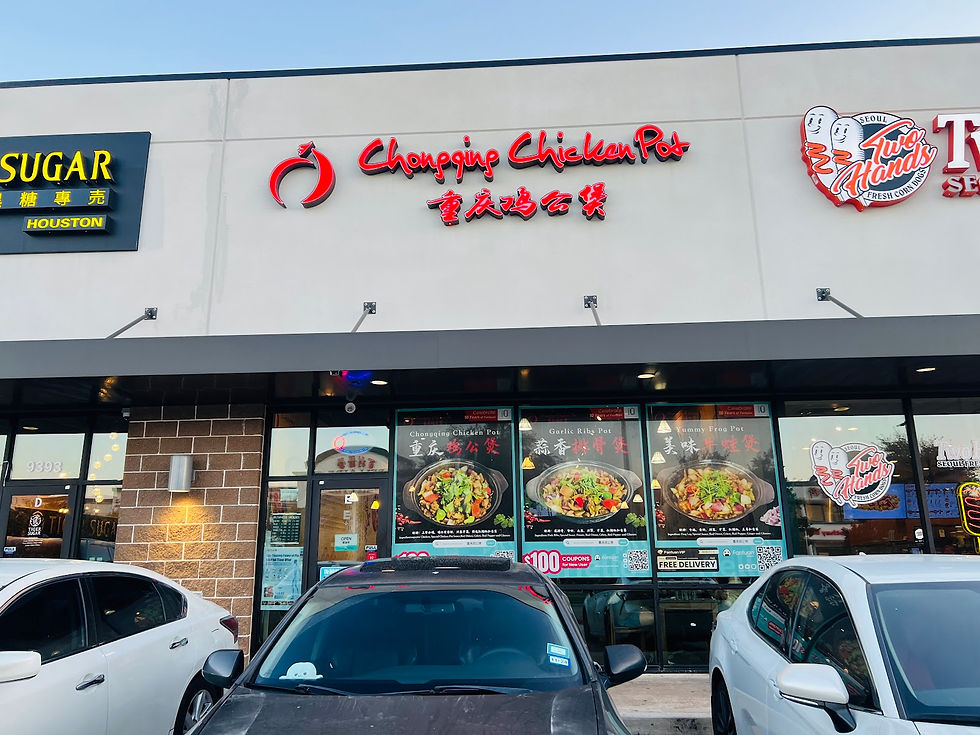
Storefronts at Bellaire Food Street. Photo: Na Li (娜爷 大圣国际传媒有限公司) via Google
Visit Details
📍 Address: 9393 Bellaire Blvd, Houston, TX 77036
🕐 Hours: Daily 11 AM–11 PM
💰 Price: Google lists $10–20 per person
📞 Phone: (346) 800-2887
🏙️ Neighborhood: Chinatown/Bellaire
Houstonia marks Bellaire Food Street's 2020 opening, with Korean, Japanese, Vietnamese, Thai and Malaysian dining, as the moment Asiatown's transformation accelerated. Its owner has filed plans for a roughly $9 million second phase, Bellaire Food District, a short distance away at 9229 Bellaire Boulevard.
💡 Local tip: Open until 11 PM daily. A state filing scheduled construction on the second phase from May 2026 to May 2027.
🌐 Website
Katy Asian Town

Storefronts at Katy Asian Town on Colonial Parkway. Photo: John N via Google
Visit Details
📍 Address: 23119 Colonial Pkwy, Katy, TX 77449
🕐 Hours: No center-wide hours listed; tenants vary
💰 Price: Varies by tenant
📞 Phone: (346) 998-8000
🏙️ Neighborhood: Katy
Katy Asian Town celebrated the grand opening of its anchor, Korean supermarket H Mart, in September 2018. Its leasing representative told the Chronicle it was built for Chinese, Filipino, Indian, Japanese, Korean, Pakistani and Vietnamese families in Sugar Land, Katy and Cypress.
💡 Local tip: Google lists no center-wide hours, so check each restaurant before driving 20 miles west.
🌐 Website
How Should You Explore Houston's Chinese History?
Start where the story ended, not where it began. Old Chinatown has almost no public trace left, so the fastest way to understand it is through the people and businesses that carried it west.
Morning in Midtown: Siu Lap City opens at 9:30 AM and carries Long Sing's recipes from Old Chinatown.
Late morning at Diho Square: Walk the first-generation plaza, then shop Welcome Food Center.
Lunch on the boulevard: Shanghai Restaurant opens at noon most days; Hong Kong's Cafe opens at 10 AM.
Afternoon context: The Chinese Community Center is open until 5 PM Monday through Saturday.
Evening: Bellaire Food Street stays open until 11 PM daily and shows what Asiatown looks like now.
For more on the corridor's food, see our Chinatown food crawl. For the wider origin story of Houston's ethnic districts, read how the Gandhi District, Little Saigon and Chinatown started. If you are nearby, Teo Chew Temple and Harwin Drive's wholesale strip are both a short drive away. Our companion guides cover Little Saigon and why Long Point's Koreatown has not expanded. To turn any of it into a route, use Plan Your Day Houston.
Frequently Asked Questions
Why did Houston's Chinatown move from downtown to Bellaire Boulevard?
Old Chinatown in East Downtown declined as the George R. Brown Convention Center, freeways and rising land prices cut it off and made property unaffordable. At the same time, Chinese families were moving to Southwest Houston and Fort Bend County. Developers opened the first Chinese businesses on Bellaire Boulevard in 1983, close to where those families lived.
When did Houston's Chinatown start being called Asiatown?
Houstonia dates the name's spread to the mid-2000s, when Vietnamese, Korean and other Asian businesses filled the corridor. Bellaire Food Street's 2020 opening, with Korean, Japanese, Thai and Malaysian dining, accelerated the change. Many residents still call it Chinatown.
Is there anything left of Old Chinatown in EaDo?
Almost nothing. The On Leong association building has been demolished, and Long Sing Supermarket, Yen Huong Bakery and Kim Son's downtown flagship have all closed. The I-45 rebuild underway in East Downtown is expected to remove the remaining structures.
Where is Houston's Chinatown today?
Houston's Chinatown runs along Bellaire Boulevard in Southwest Houston, with its earliest Chinese plazas east of Beltway 8 around Diho Square at 9100 Bellaire. The broader Asiatown district stretches west past the Beltway into Little Saigon. Katy Asian Town, 20 miles west, serves suburban Asian families.
Is Chinatown or Asiatown the correct name?
Both are in use and both have defenders. Supporters of Asiatown say it reflects the district's many cultures, while critics say it erases the Chinese families who built it. Google Maps labels the core as Chinatown.
Sources
Houston History Magazine, "Relocation, not Dislocation: Organizational Continuity across Houston's Chinatowns" (December 2025)
University of Houston, Mapping Houston's Old Chinatown project
Houstonia Magazine, "Reflecting on Four Decades of Houston's Asiatown" (May 2023) and "Don't Call It Asiatown" (November 2025)
Houston First Corporation, George R. Brown Convention Center history; GRB official site
Rice University Baker Institute, "Houston's Freeways: Who Was Displaced and Why?" (2024)
Rice University Kinder Institute, Asian American Community Study (January 2026)
Houston Chronicle reporting on Old Chinatown and the I-45 project (2022), Houston Center (1970 archive), Katy Asian Town (2017, 2018) and Bellaire Food District (2025)
China Daily USA, "Houston's SW Chinatown" (2015); Houston Public Media (2023); CultureMap Houston (2017, 2018)
International Management District; East Downtown Management District (NHHIP updates, 2026)
Google Places listings checked September 11, 2026; Plan Your Day Houston DayPlannerData


Comments